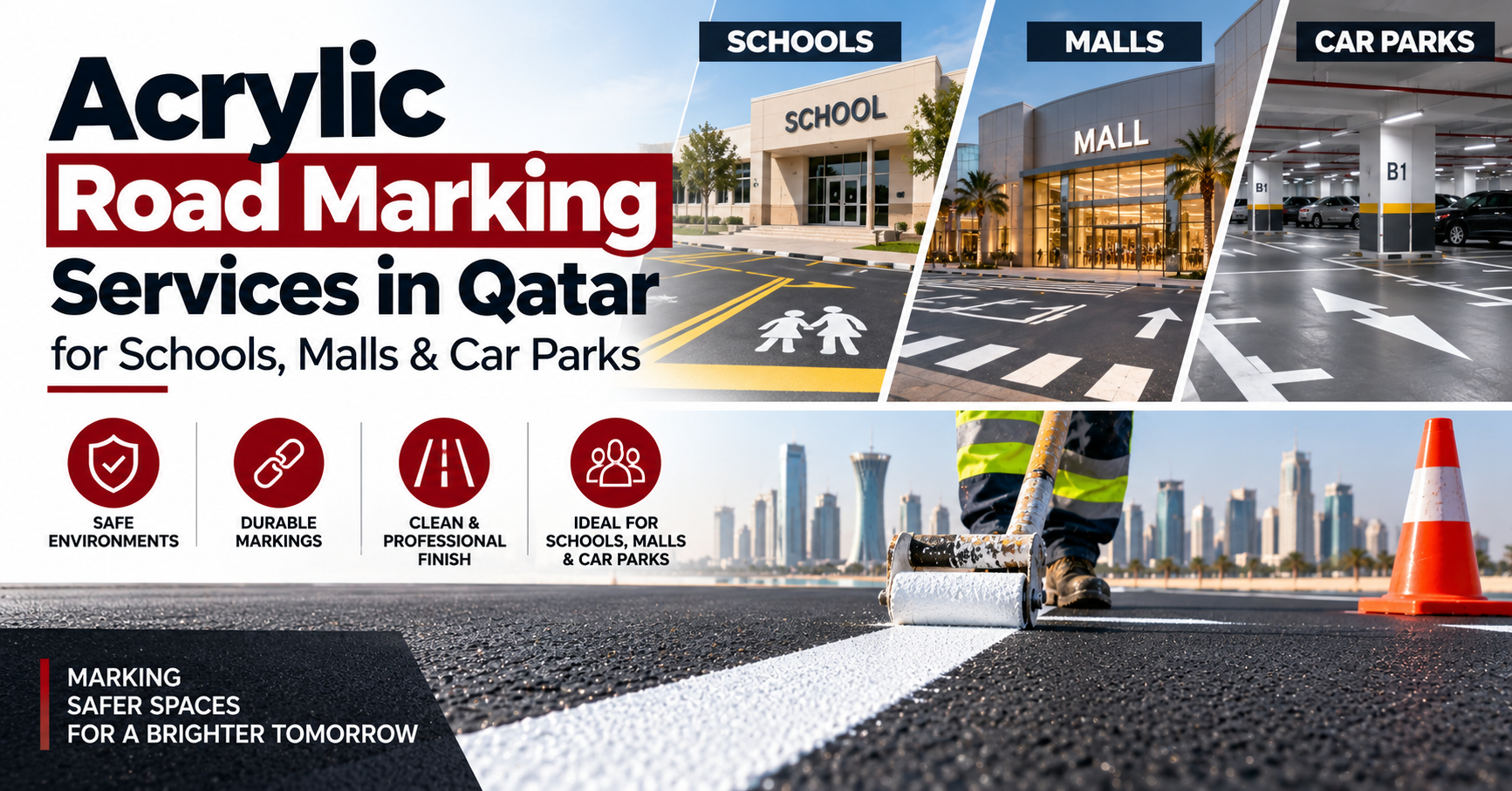
A mall management team books a car park remarking job for a Friday night. The site has to be fully open by Saturday morning. That single constraint — not durability, not price — usually decides which marking system is right.
Schools, shopping centres and parking facilities have a completely different set of problems from highways. Short working windows. Enclosed basements with no ventilation. Frequent layout changes as tenants and bay allocations shift. Pedestrian areas that need clear, colour-coded markings rather than heavy-duty road lines. This guide explains where acrylic marking fits into that picture, and what to check before you appoint anyone.
What Acrylic Road Marking Is and Why It Suits These Sites
Acrylic marking uses water-based acrylic paint applied cold — sprayed or brushed — that dries by evaporation. No heating equipment, no molten material, minimal odour.
That makes it practical in three situations where hot-applied systems are awkward:
Enclosed basements and covered car parks, where heat and fumes are a genuine constraint. Basement floor marking is the most common use.
School grounds and pedestrian zones, where work often has to happen during a short holiday window with staff and children returning immediately after.
Layouts that change, such as tenant bays, EV charging spots or reallocated visitor parking. Acrylic is easier and cheaper to overmark or remove than a thick built-up system.
Colour range matters here too. Play areas, walkway edges, disabled parking bays, fire lane hatching and directional arrow marking all rely on clear colour differentiation — something acrylic handles well.
Where Acrylic Isn't the Right Choice
Being honest about limits is more useful than a sales pitch.
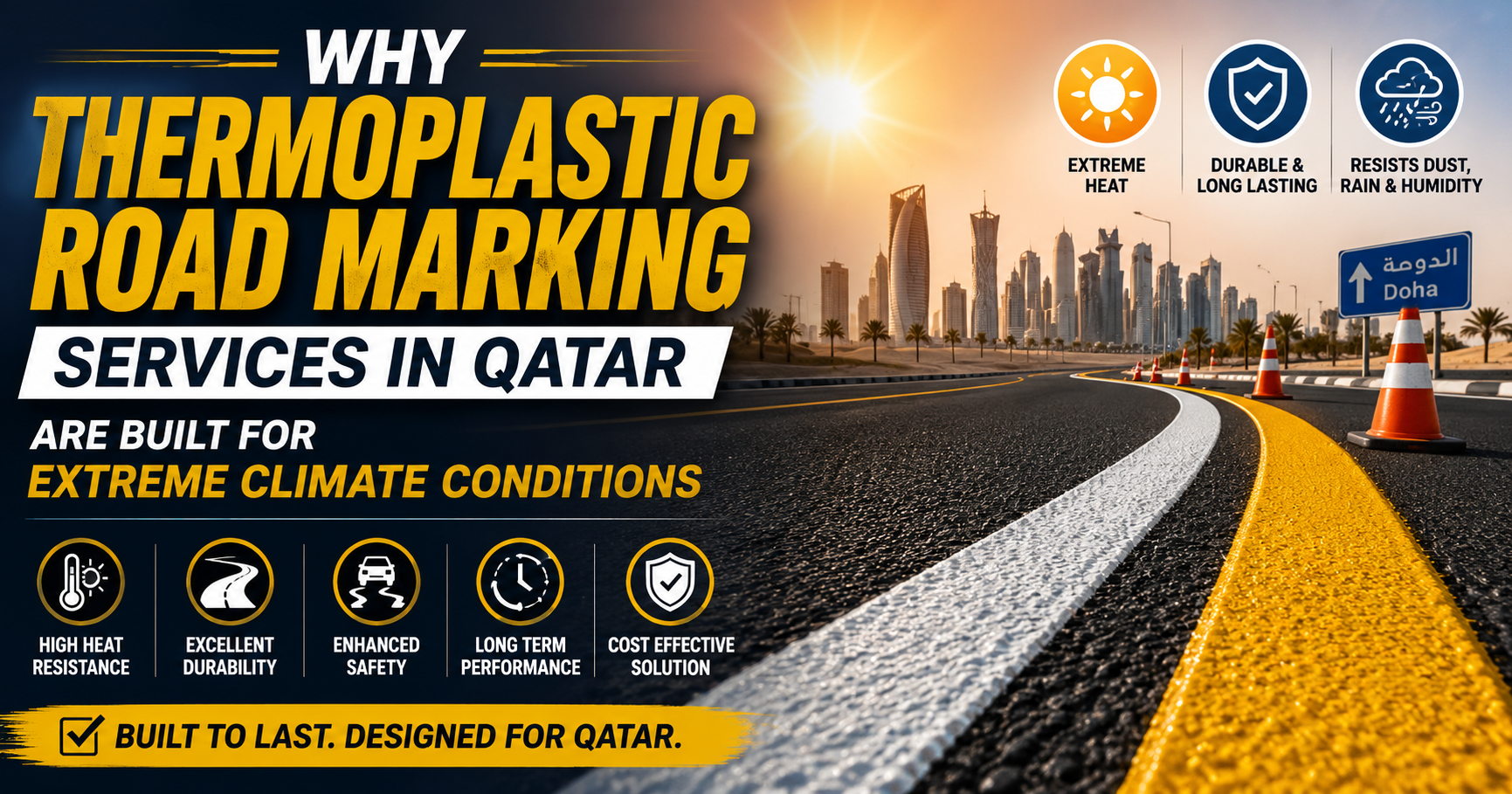
Acrylic is a thin film. On external surfaces facing Qatar's summer heat, blown sand and heavy vehicle loading, it wears faster than thermoplastic or MMA cold plastic. For arterial roads, service yards handling loaded trucks, or exposed entrance ramps taking constant turning traffic, a thicker system is normally the better long-term specification.
The practical rule most road marking contractors work to: acrylic for sheltered, moderate-traffic and frequently changing areas; thermoplastic or cold plastic for exposed, heavy-duty surfaces. Many sites need both — a basement in acrylic, the external approach roads in thermoplastic.
Why Most Acrylic Jobs Fail Early (and It's Not the Paint)
The complaint is almost always the same: the markings lifted or peeled within months. In most cases the cause is the surface, not the material.
Oil and tyre rubber. Car park decks accumulate both. Paint applied over contamination bonds to the contamination, not the concrete.
Trapped moisture. New or power-washed concrete that hasn't fully dried underneath will push coatings off from below.
Sealed or polished concrete. A smooth, sealed slab gives paint nothing to grip. It needs mechanical preparation or a suitable primer.
Rushed drying time. Reopening a bay before the film has properly cured is the fastest way to get tyre pickup and smeared lines.
Good surface preparation — degreasing, scrubbing, sometimes grinding — is the difference between a marking that lasts and one that gets redone next year.
What Should You Check Before Choosing a Marking Contractor?
Five questions worth asking before you award the work:
Which system are you recommending, and why for this specific surface? A provider who quotes the same product for a basement and an external ramp isn't assessing the site.
What surface preparation is included in the price? If it isn't itemised, assume it isn't happening.
What is the realistic drying and reopening time? Get this in writing against your access window.
Will existing markings be removed or overmarked? Failing paint underneath will take the new layer with it. Road marking removal by jet washing or abrasive blasting may be needed first.
Do the layout and symbols follow Qatar requirements? Traffic-related markings should align with the Qatar Traffic Control Manual (QTCM) and Qatar Construction Standards 2014 (QCS 2014).
Planning Your Next Marking Programme
For schools, malls and parking facilities, the right choice usually comes down to three things: how enclosed the area is, how heavy the traffic is, and how long you can close the space. Acrylic wins on access speed, low odour and flexibility. Heavier systems win on exposed, high-load surfaces.
As a road marking company working across Doha, Road Marking Qatar carries out acrylic marking alongside thermoplastic, MMA cold plastic, road studs and marking removal by sand blasting and jet wash — so the system is matched to the surface rather than to one product.
If you're planning work during a school break or an overnight mall closure, request a site survey before you finalise the schedule: +974 3118 2348 or sales@roadmarkingqatar.com.
Frequently Asked Questions
How long does acrylic marking take to dry?
Touch-dry is usually quick, but full cure takes longer and depends on temperature, humidity and airflow — enclosed basements dry more slowly than open decks. Confirm the reopening time with your contractor against your actual access window.
Is acrylic marking suitable for outdoor car parks in Qatar?
It can be used, but on exposed surfaces with heavy traffic it wears faster than thermoplastic. For open-air decks with high turnover, a thicker system usually gives better value over time.
Can acrylic be applied over old markings?
Only if the existing layer is sound and well bonded. Loose, flaking or heavily worn markings should be removed first.
What's the difference between acrylic and thermoplastic marking?
Acrylic is a cold-applied paint that dries by evaporation and leaves a thin film. Thermoplastic is heated and applied molten, producing a much thicker, longer-wearing layer. Acrylic suits sheltered and changeable areas; thermoplastic suits exposed, high-traffic surfaces.
Can school playgrounds be marked with acrylic paint?
Yes — the colour range and low odour make it a common choice for play areas, walkways and pedestrian zones. Confirm the product is suitable for the substrate and for use around children.

Gate No: 154, Street No: 24,
Doha, Qatar