Some junctions collect incidents. Same approach, same type of collision, year after year — usually a vehicle that could not stop in the distance available.
The instinct is to add more signage, repaint the lines, or lower the speed limit. Those help. But if drivers are braking hard on a smooth, polished surface, the problem is not what they can see. It is what the tires can grip. That is the gap high friction surfacing is designed to close, and it is one of the most direct road safety interventions available on an existing carriageway. Before any roadmarking company in Qatar quotes for a junction treatment, this is the part worth understanding first.
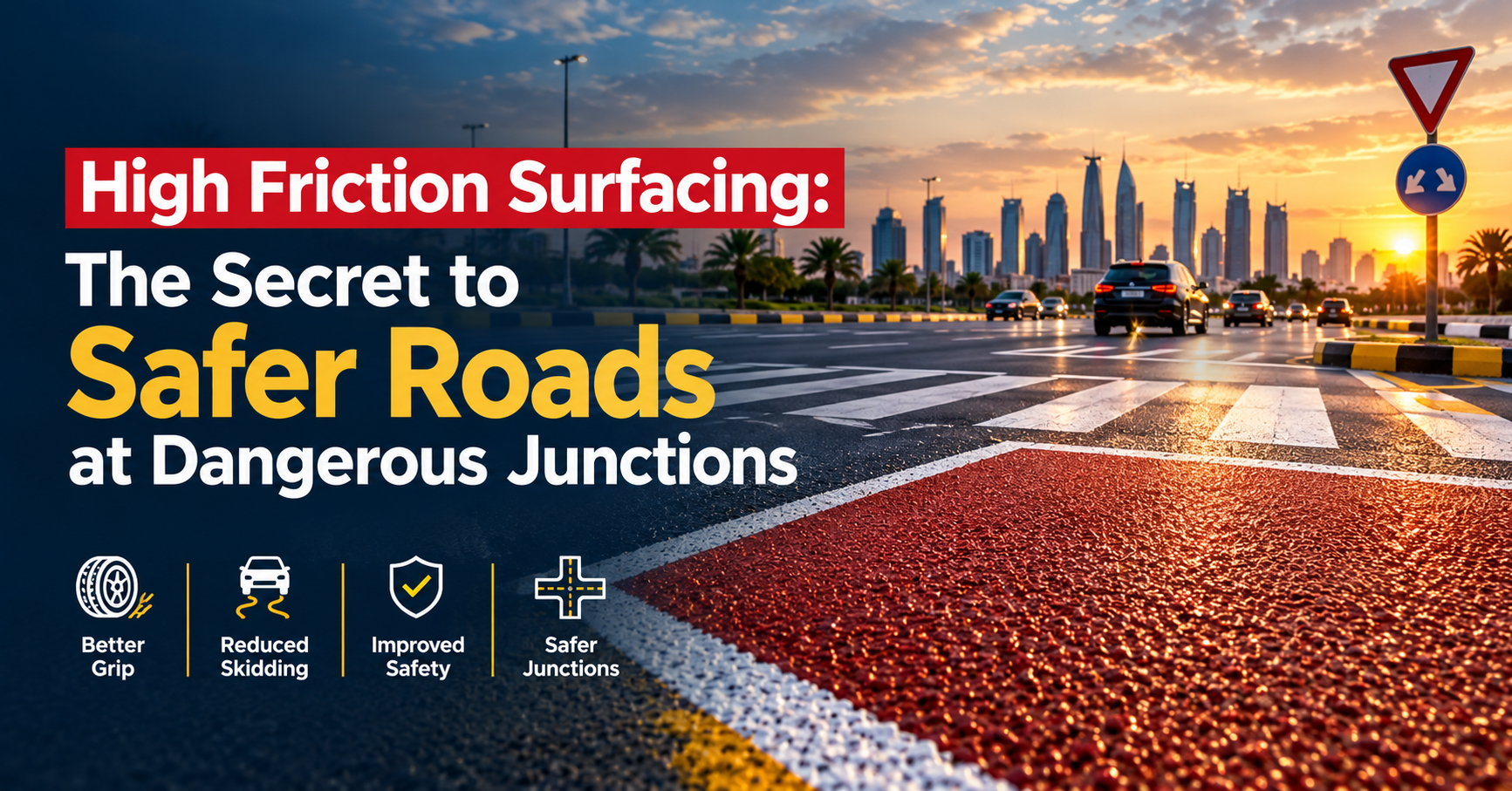
High friction surfacing — also called anti-skid surfacing — is a thin layer of hard, angular aggregate bonded to the road with a resin binder. The aggregate is usually calcined bauxite, chosen because it stays sharp instead of polishing smooth under traffic.
The result is a rough, high-grip running surface. It does not change the road layout or the drainage. It changes one variable: how much grip a tyre has when a driver brakes hard.
In practical terms, better skid resistance means a shorter braking distance on the approach — particularly in the wet, and particularly where a surface has been polished by years of turning and braking traffic.
High friction surfacing is not a general road treatment. It is applied selectively, at the specific points where hard braking happens:
A road safety audit or an incident history usually identifies these locations better than a site walk does. If a location keeps producing the same type of collision, it is a candidate.
Aggregate in asphalt polishes over time. Tyres, sand and heat gradually smooth the exposed stone faces, and a surface that tested well when new can drop significantly after years of service. Engineers describe this resistance to polishing as polished stone value — a measure of how well a stone keeps its texture under traffic.
Qatar adds two accelerators. Blown sand acts like a constant abrasive, and high surface temperatures soften bitumen, allowing aggregate to be pushed down and worn flat more quickly at braking zones.
The visible symptom is a shiny, dark patch in the wheel paths on a junction approach. That shine is the warning.
Most premature failure comes down to the same causes seen across surface treatments.
Surface condition. The existing asphalt must be sound. Laying a thin treatment over cracked, rutted or delaminating pavement simply inherits the defect underneath.
Cleanliness and dryness. Dust, oil and trapped moisture prevent the binder from bonding.
Application conditions. Resin systems have temperature and cure windows. Rushing reopening is a reliable way to lose aggregate in the first weeks.
Aggregate quality. Not all anti-skid aggregate is equal. Softer stone polishes and the treatment quietly stops doing its job while still looking intact.
Five questions that separate a considered proposal from a priced guess. Experienced road marking contractors should be able to answer all five without hesitation:
A dangerous junction is rarely a single-cause problem. Sightlines, signal timing, marking condition, night-time visibility and surface grip all contribute. High friction surfacing addresses one of them well — and works best when the road marking services at the same location are specified in the same exercise rather than treated separately.
If you are reviewing a junction, a roundabout approach or a crossing and want the marking scope assessed alongside the surface treatment, a site survey before the specification is locked usually saves a variation later. Work should be executed in line with the Qatar Traffic Control Manual (QTCM) and Qatar Construction Standards 2014 (QCS 2014).
Speak to Road Marking Qatar on +974 3118 2348
What is high friction surfacing made of?
A hard, angular aggregate — commonly calcined bauxite — bonded to the road using a resin binder. The aggregate provides grip; the binder holds it in place.
How is it different from normal road resurfacing?
Resurfacing replaces the wearing course across a whole stretch. High friction surfacing is a thin overlay applied selectively at specific hazard locations to increase grip, without rebuilding the pavement.
Does it work in wet conditions?
Improving grip in the wet is one of its main purposes. The coarse texture helps displace surface water so the tyre keeps contact with the aggregate.
How long does high friction surfacing last?
Service life depends on traffic volume, braking intensity, aggregate quality and the condition of the pavement beneath. Heavily braked junction approaches wear faster than lightly trafficked sites.
Can it be applied over existing road markings?
Markings within the treated area are normally removed or reinstated afterwards. Leaving them under the treatment creates a weak bond line.

Gate No: 154, Street No: 24,
Doha, Qatar