Deep Research · Market Intelligence · March 2026
Ashghal just awarded QR 4.5bn in Q1 2026 alone — with another QR 7bn in tenders imminent. AI-powered road markings, autonomous vehicle compatibility, and 67 active projects are reshaping what contractors need to deliver.
⚡ Breaking — Q1 2026
Ashghal unveils QR 11.5bn infrastructure package — 12 projects worth QR 4.5bn awarded in Q1 2026 alone
The Public Works Authority (Ashghal) confirmed in February 2026 it is implementing 20 active projects valued at over QR 11.5 billion. Contracts awarded in Q1 2026 include the Hamad General Hospital redevelopment (QR 1.179bn), the Al Thumama postal building, and road networks in Izghawa and Al Thumid — all assigned to Qatari companies.
A further eight projects worth approximately QR 7bn are scheduled for upcoming tender, including two major strategic drainage tunnels and residential infrastructure across the country.
Qatar's road marking market is entering a new phase. The post-FIFA 2022 consolidation period is over. Ashghal has outlined 67 projects across its 2026 pipeline — spanning highways, ITS, drainage, schools, hospitals, and residential infrastructure. Every one generates direct demand for compliant road markings.
The global road marking coatings market is valued at USD 8.38 billion in 2026, growing at a 6.38% CAGR through 2035 — driven by infrastructure investment, stricter safety standards, and the fast-emerging requirement for autonomous vehicle-compatible markings. Qatar sits at the intersection of all three drivers.
Understanding what Ashghal is building tells you exactly where road marking demand is concentrated. Based on Ashghal's own published updates for 2026:
New internal roads for citizen land plots requiring full thermoplastic lane marking, pedestrian crossings, directional arrows, and road studs to QTM standards.
Full campus road and car park marking — ambulance bay delineation, disabled bays, fire lanes, pedestrian routes, and internal directional markings across a large medical site.
ITS deployment along Qatar's strategic roads uses AI-managed signals and ALPR cameras — all requiring machine-readable, high-contrast thermoplastic markings with documented retroreflectivity.
Five-year O&M contracts using AI asset management, self-driving inspection vehicles, and laser defect detection — creating ongoing, structured demand for marking maintenance and repainting to measurable retroreflectivity thresholds.
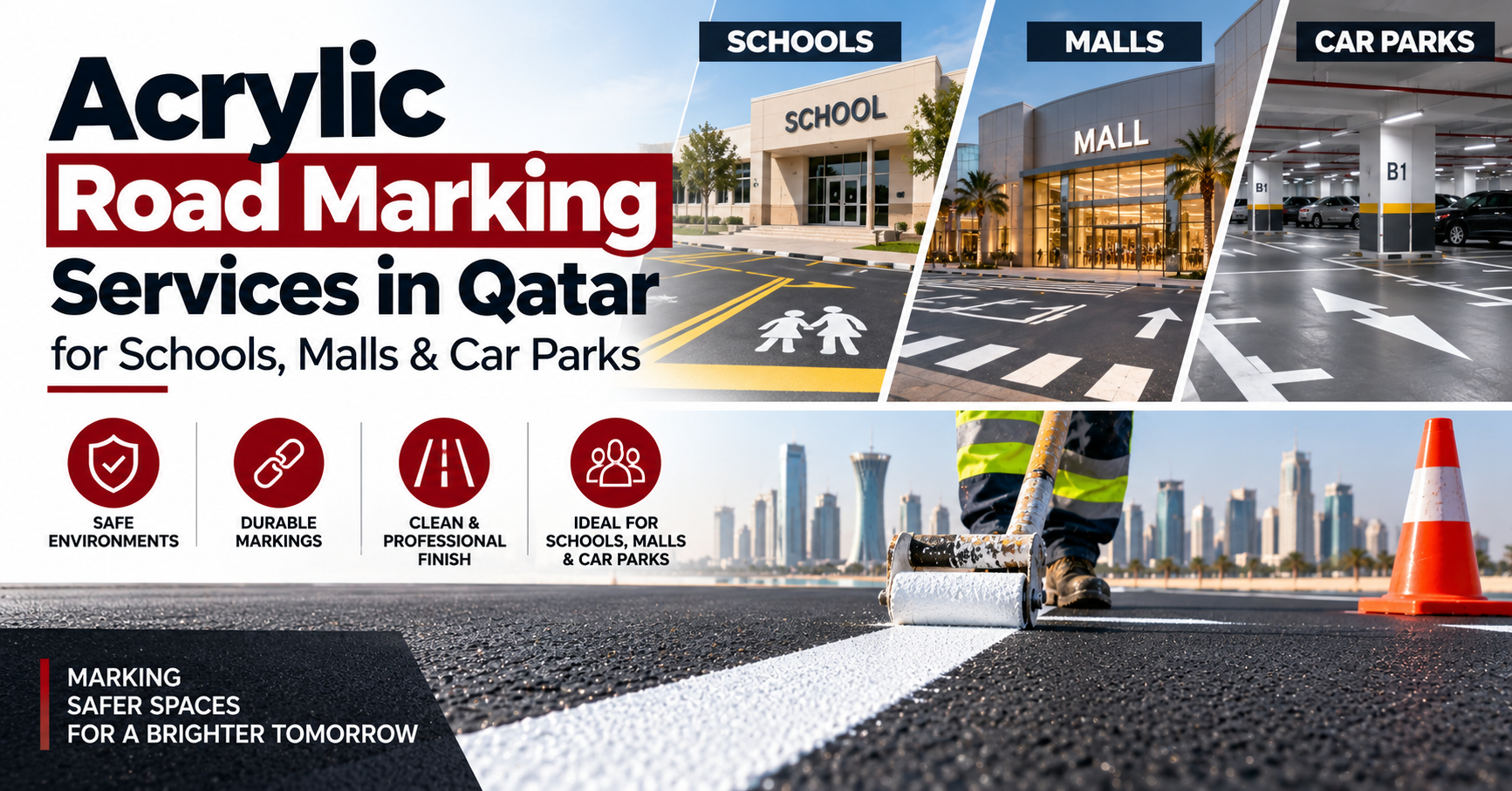
Upgrades to 40 schools require new school zone road markings — yellow thermoplastic warning zones, pedestrian crossings, no-stopping zones, and parent drop-off delineation under QTM and Civil Defense standards.
Tunnels demand specialist highly reflective, rapid-cure thermoplastic compounds with enhanced retroreflectivity for enclosed, high-traffic environments with limited natural light.
One of the most significant shifts in the global road marking industry is the convergence of traditional markings with intelligent transportation systems. Ashghal's QR 12bn contract package includes AI-based digital asset management, self-driving survey vehicles, and laser-based road defect detection — all technologies that depend on consistently visible, retroreflective, machine-detectable markings.
Globally, companies are testing coatings embedded with magnetic particles and specialised pigments detectable by autonomous vehicle sensors in fog and low-visibility conditions. Researchers at Oak Ridge National Laboratory have embedded low-power sensors in raised pavement markers that transmit real-time road shape data to passing autonomous vehicles. An ESA-backed startup called 10Lines is launching autonomous road-marking robots using satellite site-mapping, with full market rollout expected in 2026.
🤖
AI-Compatible MarkingsALPR cameras and AI traffic systems require high-contrast, machine-readable markings. Standard faded paint is undetectable — creating non-compliance risk on ITS-equipped roads.
💡
High Retroreflectivity StandardsIndustry research shows better road marking visibility reduces nighttime accidents by up to 20%. Autonomous vehicle sensors require markings well above basic QTM thresholds.
📡
Smart Sensor Road StudsLow-power microchip sensors embedded in raised pavement markers can transmit live road geometry to autonomous vehicles in fog, glare, and poor-visibility conditions.
🌱
Low-VOC Sustainable MaterialsVision 2030 sustainability goals are driving preference for low-VOC, lead-free thermoplastic formulations on public projects in Qatar. Sherwin-Williams launched a fast-dry waterborne paint in Oct 2025 reducing lane closure times by 40%.
| Indicator | Figure | Source |
|---|---|---|
| Ashghal 2025–2029 plan | QR 81bn ($22.2bn) | Ashghal, May 2025 |
| Ashghal Q1 2026 awards | QR 4.5bn — 12 contracts | Gulf Times, Feb 2026 |
| Upcoming Ashghal tenders | ~QR 7bn — 8 projects | Zawya / Ashghal, 2026 |
| Ashghal 2026 project pipeline | 67 active projects | MEED, Jan 2026 |
| Global road marking coatings market (2026) | USD 8.38bn | 360 Research, 2026 |
| Global market CAGR to 2035 | 6.38% | 360 Research, 2026 |
| Road maintenance as % of coating demand | ~45% | 360 Research, 2026 |
| Nighttime accident reduction from improved markings | Up to 20% | Industry research, 2026 |
Ashghal is delivering internal road networks for 5,500+ residential plots under PPP arrangements. Each requires full thermoplastic marking: lane lines, stop bars, crosswalks, school zones, and road studs to QTM standards.
Hamad General Hospital, schools, Lusail, and Qatar's expanding mall network all need professional car park marking — bay lines, disabled bays, fire lanes, directional arrows, and entry/exit delineation using thermoplastic or cold paint depending on traffic volume.
Each school requires yellow thermoplastic school zone markings, enhanced pedestrian crossings, no-stopping zones, and parent drop-off delineation meeting current QTM and Qatar Civil Defense requirements.
Five-year O&M road contracts create structured, ongoing demand for repainting. Ashghal's AI asset management platform will flag markings below retroreflectivity thresholds automatically — driving faster, data-triggered maintenance cycles than ever before.
ITS deployment along Qatar's strategic corridors creates demand for markings reliably detectable by cameras, sensors, and AI systems — requiring higher glass bead density, tighter retroreflectivity specs, and documented QA testing at handover.
With Ashghal's AI platforms monitoring retroreflectivity on O&M roads, contractors who deliver and document above-minimum readings at handover are building a verifiable track record that protects them in contract disputes and future tender bids.
ITS packages increasingly bundle road marking with digital traffic systems. Contractors who can demonstrate knowledge of machine-readable marking specifications will score stronger in technical evaluation criteria.
As major Ashghal O&M contracts go to international contractors, local road marking companies are finding stronger margins in private sector work — malls, hospitals, warehouses, hotels — where procurement cycles are faster and competition is lower.
Qatar's sustainability goals under Vision 2030 are increasingly reflected in project specifications. Low-VOC, lead-free thermoplastic formulations are preferred on public projects and differentiate tender submissions.
Ashghal's 40-school and hospital programmes are sub-contracted to Qatari firms. A strong delivery record on these builds a reference portfolio that unlocks larger road network tenders — and positions contractors well ahead of the QR 7bn upcoming tender wave.
Ashghal has outlined 67 projects across its 2026 development strategy covering highways, roads, ITS, drainage, and buildings. In Q1 2026 alone, 12 contracts worth over QR 4.5bn were awarded, with eight more projects worth approximately QR 7bn scheduled for upcoming tender.
ITS systems including AI cameras, ALPR enforcement, and self-driving survey vehicles all rely on consistently retroreflective, machine-readable road markings. This raises the practical standard beyond the basic QTM threshold — contractors need higher glass bead densities and documented retroreflectivity testing at handover.
Yes. Ashghal's stated policy is to prioritise Qatari companies. The Q1 2026 package explicitly noted that all awarded projects went to national firms. Sub-contracting of specialist works such as road marking from main contractors to local companies is common on these programmes.
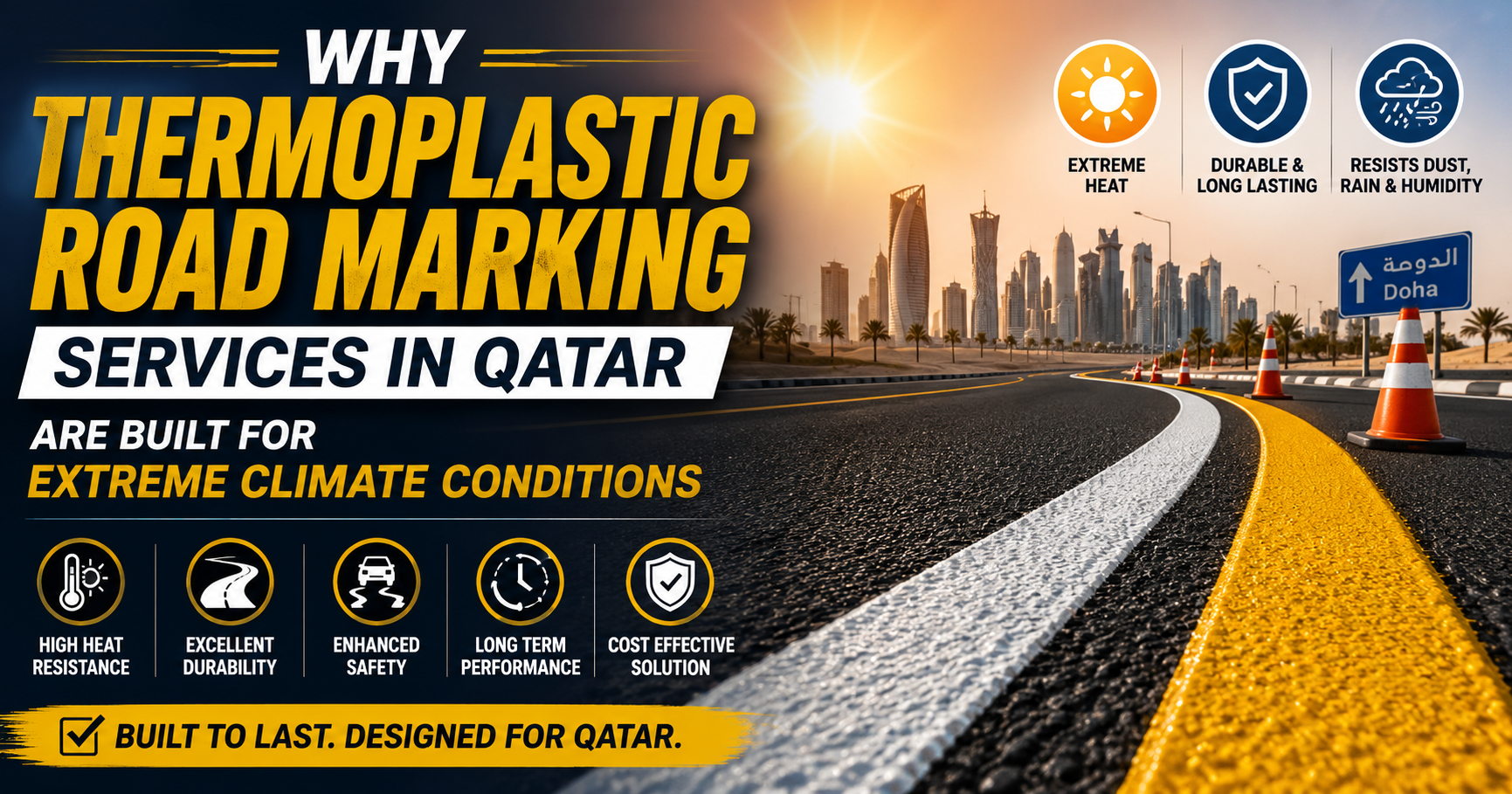
For high-traffic car parks such as hospitals and malls, thermoplastic is recommended — lasting 3–5 years versus 3–12 months for cold paint in Qatar's heat. For low-traffic or sheltered indoor areas, cold paint is more cost-effective. The right choice depends on traffic volume, UV exposure, and client maintenance budget.
With QR 11.5bn in active projects and QR 7bn in upcoming tenders, the demand for compliant, high-quality road marking has never been stronger. Road Marking Qatar delivers Ashghal-compliant thermoplastic solutions across highways, car parks, school zones, and ITS-compatible marking applications.
Get a Quote Today →
Gate No: 154, Street No: 24,
Doha, Qatar