Complete Industry Guide · 2025
Qatar's QR 81 billion infrastructure plan is driving unprecedented demand for compliant, durable road markings. This guide covers everything engineers, contractors and project managers need to know.
Qatar's roads are among the busiest and fastest-growing in the Gulf. With Ashghal's landmark QR 81 billion ($22.2 billion) infrastructure plan for 2025–2029 now underway, and billions more flowing into new residential zones, expressways, and smart city corridors, the demand for high-quality road marking has never been higher.
Yet road markings are often the last item discussed and the first to fail. Faded lines, worn crosswalks, and invisible lane dividers contribute directly to accidents, traffic congestion, and non-compliance with Qatar's strict road safety standards. Choosing the right material and contractor from the start is not just a technical decision — it's a safety and financial one.
There are four main types of road marking materials used in Qatar. Each has specific use cases, performance profiles, and cost implications.
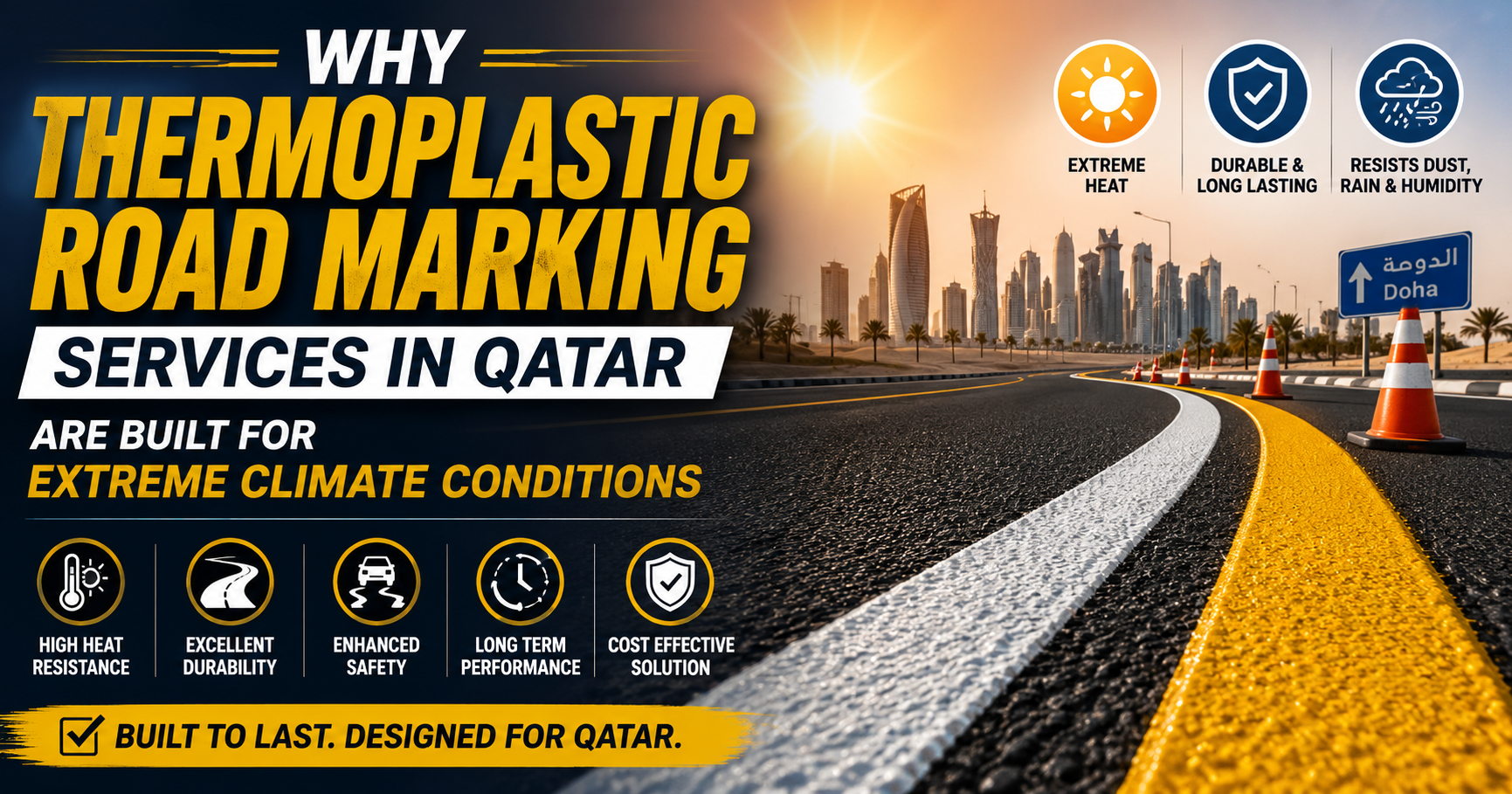
The gold standard for Qatar roads. A solid powder mixture heated to 180–220°C, applied by screed, extrusion, or spray. Forms a thick, durable, retroreflective surface bonded tightly to asphalt.
Applied at ambient temperature — no heating required. Cheaper upfront but lasts only 3–6 months in Qatar's heat. Best for temporary markings, car parks, and warehouse floors. Not recommended for permanent infrastructure.
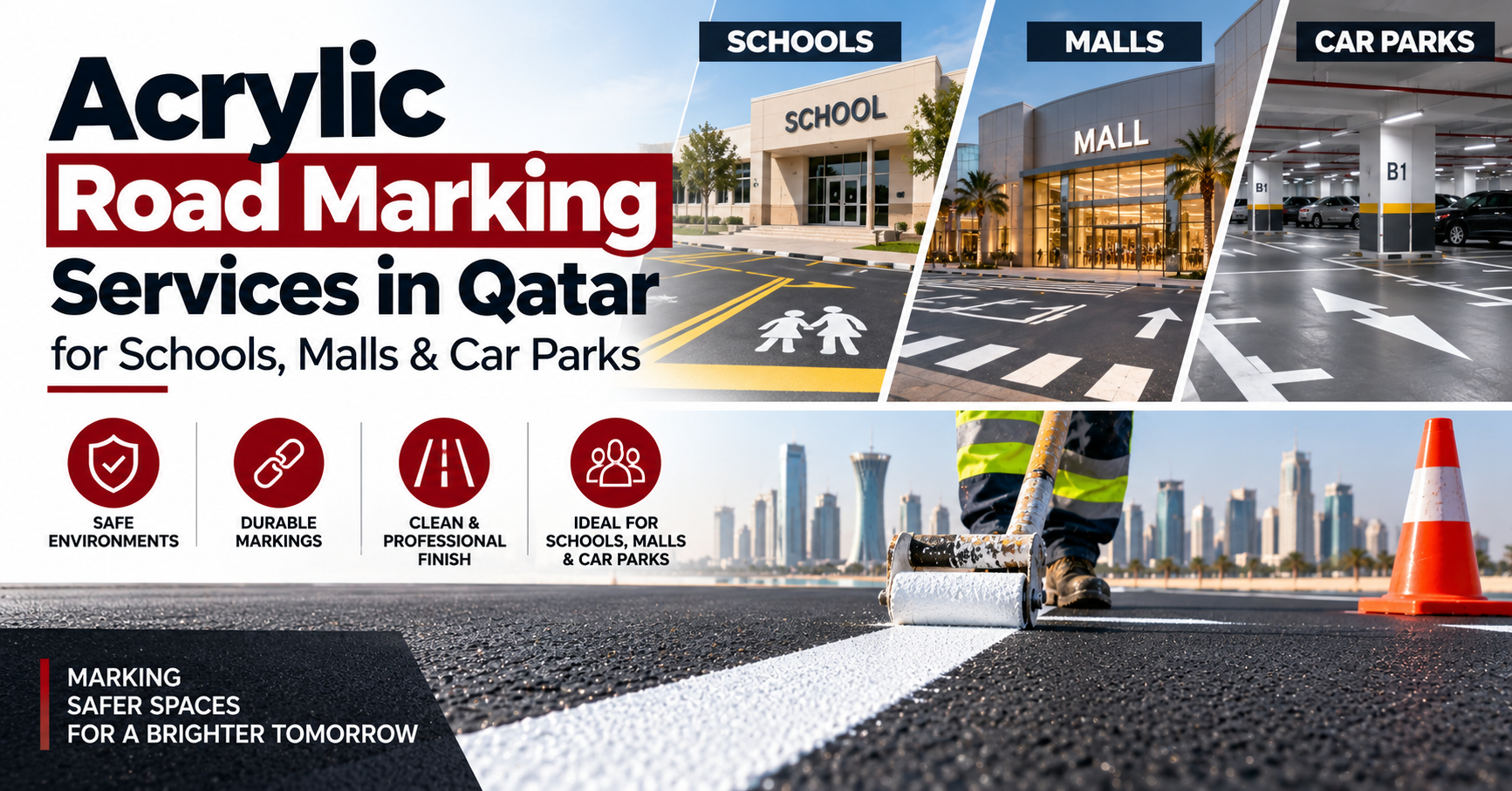
Combines thermoplastic durability with cold-application speed. Cures in 15–30 minutes, bonds to asphalt and concrete without primer. Ideal for bicycle lanes, school zones, and coloured pedestrian crossings.
Factory-cut symbols, arrows, and crosswalk patterns applied with a propane torch. Consistent thickness, fast installation, precise detailing — widely used for intersection and junction markings across Qatar.
| Factor | Thermoplastic | Cold Paint |
|---|---|---|
| Durability | 3–5 years | 3–12 months |
| Retroreflectivity | High — embedded glass beads | Low — surface beads only |
| Heat resistance | Excellent | Poor |
| Long-term cost | Lower — less repainting | Higher — frequent repainting |
| Ashghal compliance | Yes — standard for major roads | Temporary use only |
| Best use | Highways, urban roads, crosswalks | Car parks, temporary markings |
The Public Works Authority (Ashghal) governs road marking standards through the Qatar Traffic Manual (QTM) and associated Infrastructure Advisory Notes (IANs). Key requirements include:
Only Ashghal-approved materials may be used on PWA projects. Contractors must submit material test certificates and datasheets before commencement.
White for lane lines, edge markings, stop bars and crosswalks. Yellow for centre lines on two-way roads, school zones, and no-parking zones.
Minimum retroreflectivity levels must be met. Glass beads must be pre-mixed and applied as drop-on beads simultaneously during application.
Screed thermoplastic must achieve a minimum thickness of 1.5mm. Spray specifications vary by road type and application method.
White = lane lines. Red = left edge. Amber = central reservations. Green = slip roads. All installed at Ashghal-specified intervals on highways.
Qatar's infrastructure pipeline is creating sustained demand for road marking services. Key drivers include:
🛣️
Highway & ExpresswayCentre lines, edge lines, lane dividers, chevrons, countdown markers
🏙️
Urban RoadsLane markings, bus lanes, bicycle lanes, pedestrian crossings
🚶
Crosswalks & School ZonesZebra crossings, raised crosswalks, anti-slip school zone markings
🅿️
Car ParksBay lines, directional arrows, disabled spaces, fire lane markings
🔀
Intersections & JunctionsStop bars, give-way lines, directional arrows, box junctions
🔵
Coloured MarkingsMMA bus lanes, cycle lanes, school zones in red, green, blue
Verify the contractor has direct PWA project experience and can provide references from Ashghal-approved works.
Purpose-built self-propelled marking machines, truck-mounted hot-melt kettles, and computerised line/space control systems are essential.
Approved materials with certified glass bead content and proven retroreflectivity performance are non-negotiable for compliant works.
Look for retroreflectivity testing, thickness measurements, and documented QA throughout the application process.
Road marking in live traffic demands strict traffic management protocols, trained crews, and full safety documentation.
Even the best thermoplastic markings degrade over time. Qatar's high UV index, extreme surface temperatures, heavy trucks, and sandstorms accelerate wear faster than temperate climates. A proactive maintenance approach includes:
Under normal high-traffic conditions, thermoplastic markings typically last 3–5 years. Longevity depends on traffic volume, surface preparation quality, material specification, and correct application temperatures.
Screed pushes molten thermoplastic through a die for thick, uniform lines — ideal for lane markings and crosswalks. Spray uses compressed air for a thinner layer, suited for rapid maintenance repainting. Both are used in Qatar per Ashghal specifications.
Yes. Ashghal specifications require retroreflective markings on all public roads. Glass beads must be both pre-mixed into the thermoplastic and applied as drop-on beads during application for immediate and sustained reflectivity.
Yes, with experienced crews and Gulf-formulated materials. Work is typically scheduled during cooler early morning hours or at night where traffic management permits, using thermoplastics specifically formulated for extreme heat.
Road Marking Qatar delivers Ashghal-compliant thermoplastic road marking services across all project types — from major highways to private car parks.
Contact Us Today →
Gate No: 154, Street No: 24,
Doha, Qatar