For most of its history, road marking in Qatar was a relatively stable trade. Thermoplastic on asphalt, glass beads for retroreflectivity, QCS compliance on public works — the core variables didn't shift much from cycle to cycle. That era is over.
Between 2024 and 2026, four forces have converged to fundamentally reshape what road marking means in Qatar: a post-World Cup infrastructure reset, national sustainability commitments, the government's autonomous vehicle (AV) strategy, and a materials market responding to climate performance data. Understanding these trends isn't academic for contractors, project managers, or specifiers working in Qatar. It's the difference between winning tenders and losing them.
This post breaks down the seven major trends defining road marking in Qatar right now — with practical implications for every party in the supply chain.
The post-World Cup period brought an expectation of infrastructure slowdown. What actually happened was a recalibration. Ashghal moved from stadium and highway construction to a sustained residential, logistics, and smart city programme — and the specification quality demanded by this new wave of projects is significantly higher than the road marking scope on basic road contracts.
Key active programmes driving road marking demand in 2025–2026 include:
The trend isn't just more contracts. It's that specifications on these projects are more detailed, QCS compliance is more actively monitored, and Ashghal's vendor pre-qualification process is functioning as a de facto quality filter. Companies that haven't invested in compliant processes are finding it harder to access this work.
Ashghal's cool pavement pilot on Abdullah Bin Jassim Street and Katara pathways near Souq Waqif demonstrated measurable results — surface temperature reductions of 15–20°C on treated sections compared to conventional asphalt. The authority is now actively planning to scale this programme across Doha's heat-critical zones.
For road marking contractors, cool pavement integration creates a new technical challenge that doesn't exist on conventional asphalt: the treated surface has a different porosity, texture, and thermal profile than standard bituminous surfaces. Standard thermoplastic application methods produce inconsistent bond strength and adhesion on cool pavement treatments if not adapted.
The practical implications:
Contractors who can demonstrate experience with marking on treated surface types — and who understand the adaptation required — are already differentiating themselves in project conversations.
Qatar's Ministry of Transport published an autonomous vehicle integration strategy that is now actively influencing how road marking specifications are written on Ashghal's Intelligent Transportation Systems (ITS) projects. This is the most technically significant trend reshaping road marking specification in Qatar.
The issue is well-documented in the global road safety literature: ADAS camera systems detect lane markings by processing contrast and retroreflectivity values in real time. A marking that is perfectly legible to a human driver at 100 km/h may already be below the minimum retroreflectivity threshold detectable by a forward-facing camera, particularly in sand haze, dawn light, or wet conditions.
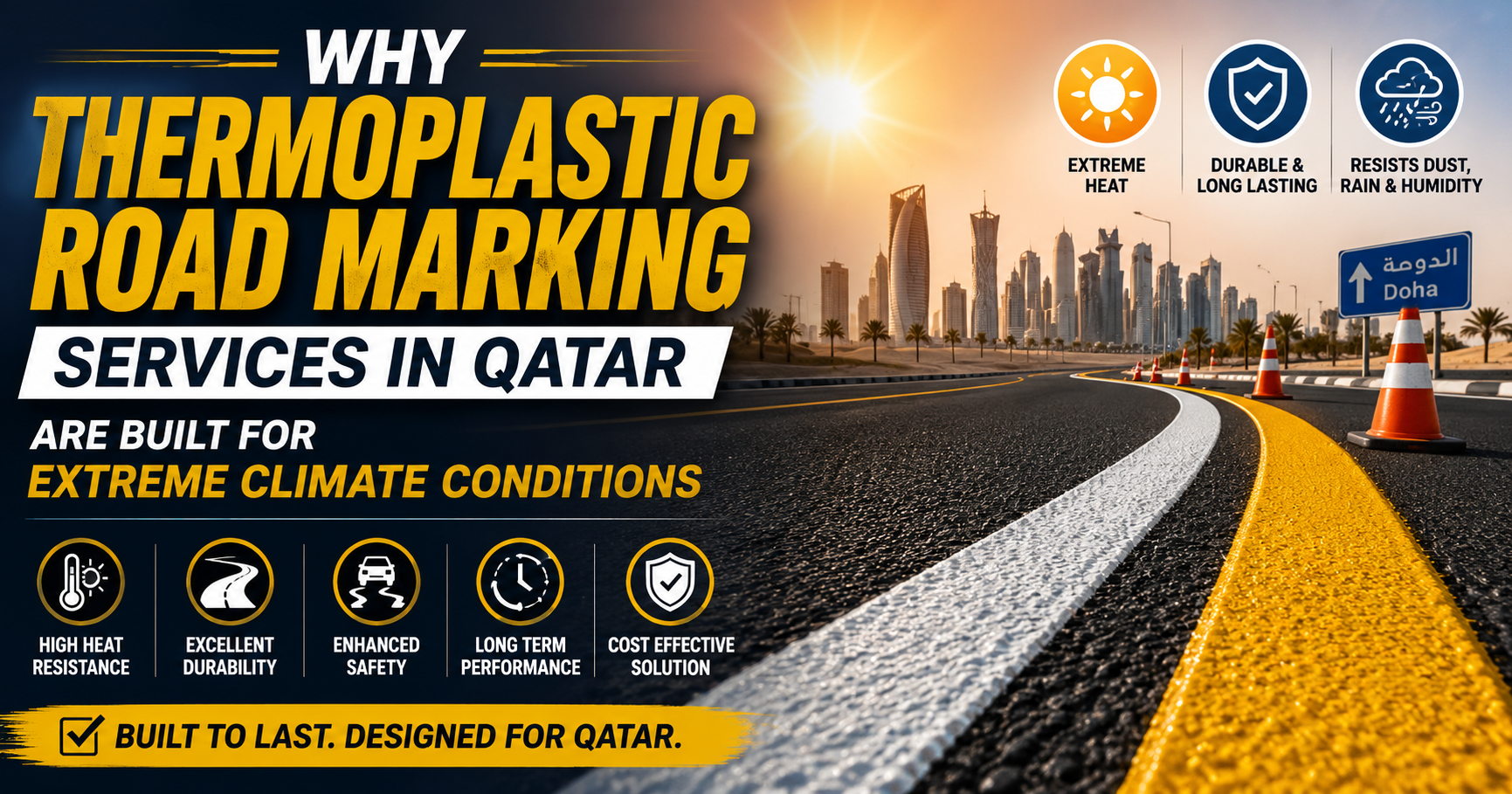
In Qatar's operating environment — where UV degradation, sand abrasion, and ground temperatures above 60°C accelerate marking deterioration — the gap between "looks acceptable to a human" and "machine-readable" closes within 18–24 months on high-traffic routes without maintenance intervention.
Emerging specification requirements for AV-ready corridors in Qatar include:
Road marking companies in Qatar that invest in retroreflectometry equipment and can provide performance documentation — not just visual QC sign-off — are ahead of the curve on this trend.
Qatar's National Environment and Climate Change Strategy 2030 set sustainability targets across the construction sector. By 2025, these targets are visible in infrastructure procurement documentation in a way they weren't in 2022. On road marking specifically, the practical impact is:
This is a trend that rewards contractors with documented supply chains and material certifications over those relying on undocumented or unverified material sourcing.
The use of cold plastic (two-component MMA systems) for coloured surface markings, pedestrian crossing treatments, cycle lanes, and decorative carriageway applications has grown significantly in Qatar since 2023. The driver is performance data: cold plastic systems consistently outperform solvent-based paint on colour retention, skid resistance, and UV stability in Qatar's climate by a factor of 3–5x service life.
Applications where cold plastic is now the expected specification in Qatar's premium development segment:
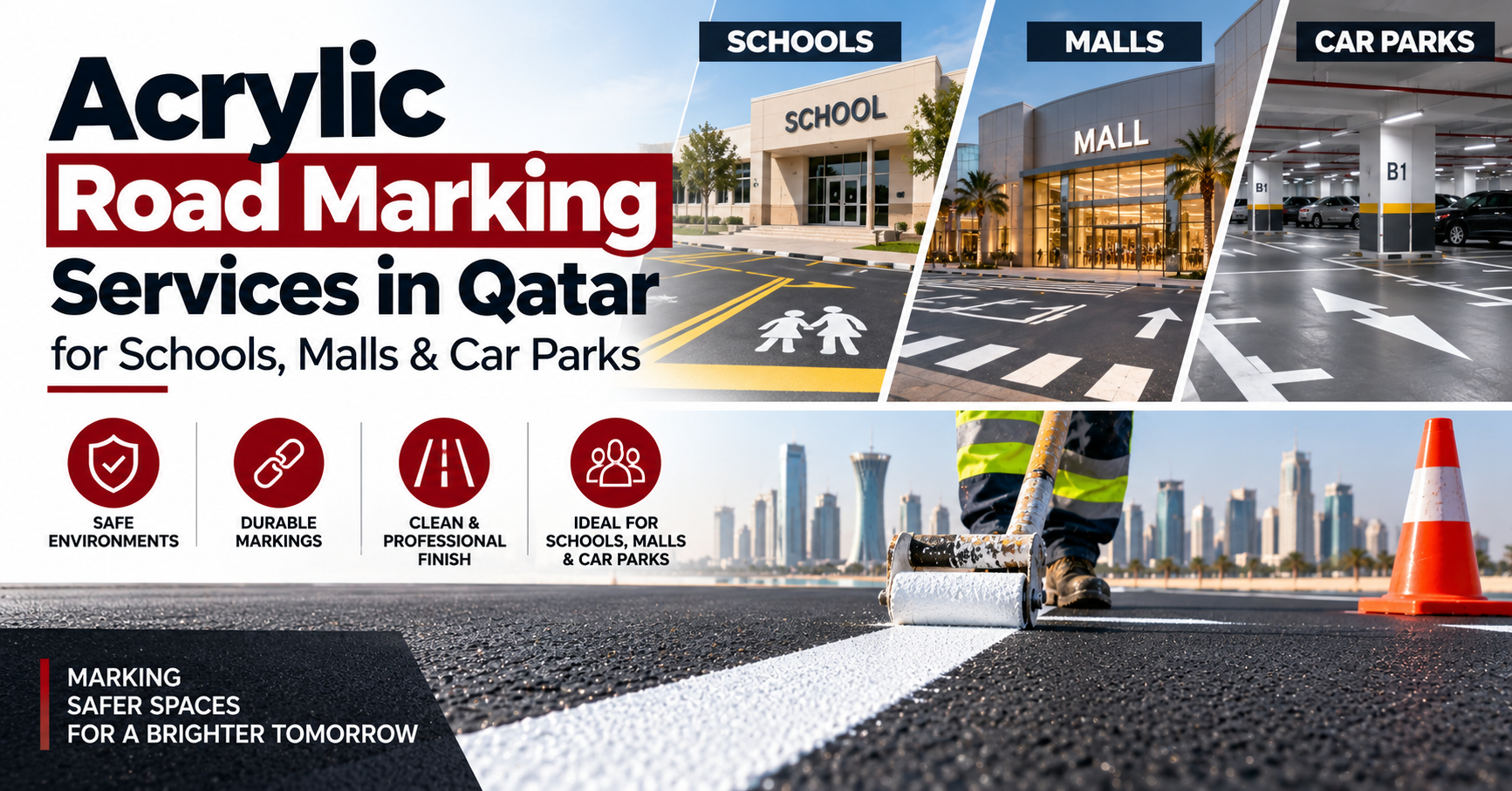
Cold plastic application requires different equipment, crew training, and surface preparation than hot-applied thermoplastic. Contractors without in-house MMA capability are being excluded from this segment of the market as developers and consultants specify it as a requirement rather than a preference.
Qatar's commercial real estate development pipeline has driven significant growth in car park marking demand — from the mega-mall expansions on the Doha Ring Road to the podium parking structures across Lusail and West Bay. Simultaneously, facility management companies operating these assets are raising their specification standards as tenant and operator expectations increase.
The car park marking segment in Qatar is experiencing a specific professionalisation trend:
For road marking companies in Qatar targeting the private sector, car park marking is the highest-volume, most accessible segment — and demand is growing faster than supply of capable operators.
A quiet but significant shift in how road marking quality is being managed in Qatar involves the move from paper-based or informal QC records to structured digital documentation. This is being driven from the top down by Ashghal's project management requirements, and from the bottom up by FM operators who need asset condition records for maintenance planning.
Contractors who document their work with GPS-referenced retroreflectivity readings, photographic records at standard intervals, digital as-built records, and structured handover packs are winning repeat business and building specification relationships with consultants who need to demonstrate compliance to clients.
Contractors who deliver work without documentation — relying on visual sign-off and no formal records — are increasingly exposed when clients ask for evidence of compliance on renewal, expansion, or dispute resolution.
The implication for road marking companies in Qatar: invest in the process infrastructure to produce and retain project records. It is not a large investment relative to the business value of being able to demonstrate a documented quality track record.
Whether you're procuring road marking as a project owner, specifying it as a consultant, or delivering it as a contractor, the 2025–2026 landscape in Qatar rewards preparation over improvisation.
As one of Qatar's established thermoplastic road marking companies, our work spans Ashghal-contracted programmes, private developments, car parks, and industrial facilities — all delivered to QCS 2014 with full documentation and retroreflectivity records.
Explore our full range of road marking services, review our line marking capabilities, or contact our team to discuss your upcoming project.

Gate No: 154, Street No: 24,
Doha, Qatar