You mark a car park in March. By August the lines have gone chalky, the edges are bleeding, and vehicles are parking wherever they like. Six months of life out of a marking job isn't a maintenance problem — it's a material problem.
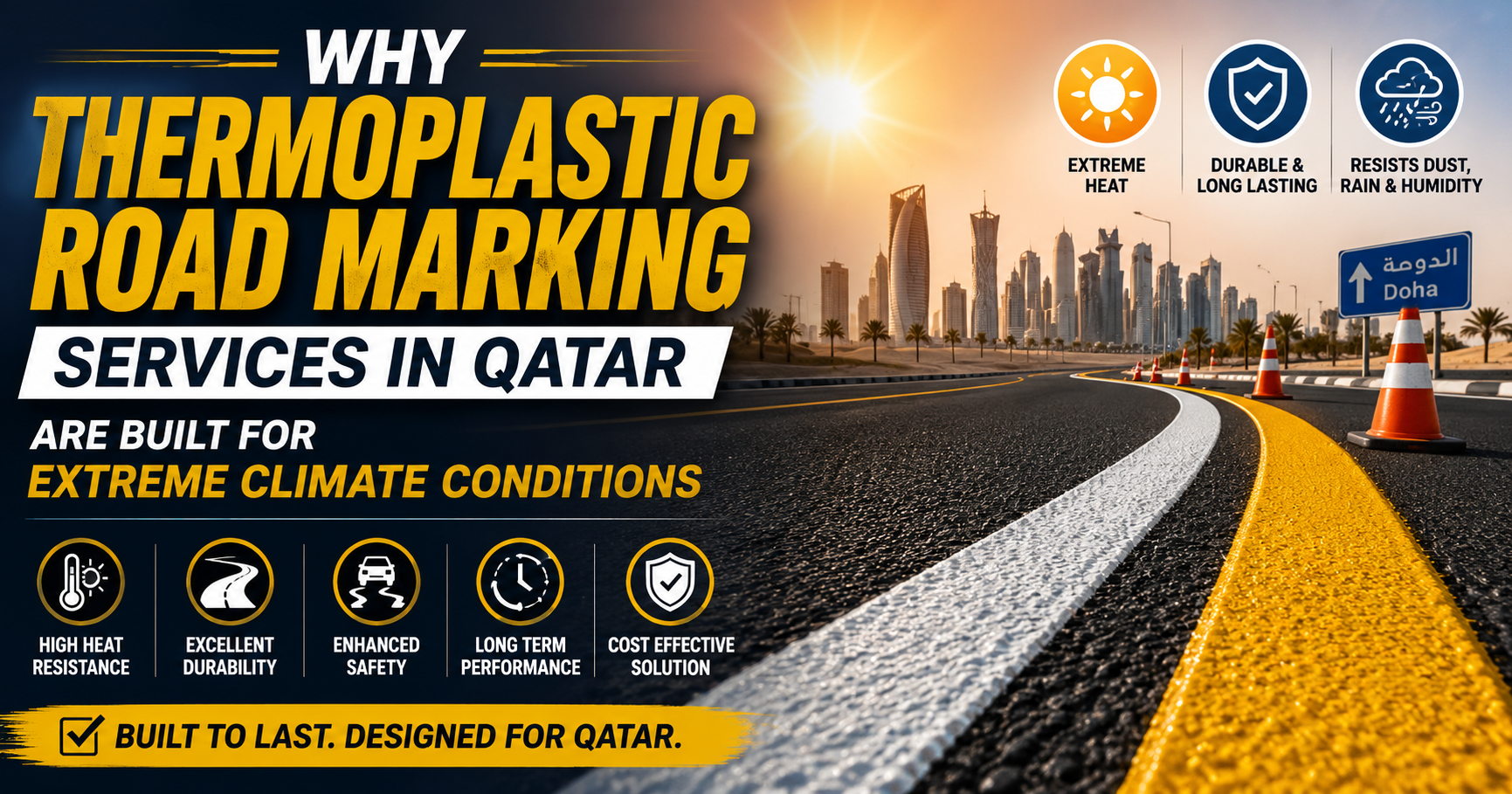
Qatar puts markings through conditions most systems were never designed for: surface temperatures far above ambient in summer, coastal humidity, blown sand acting as a constant abrasive, and heavy vehicles tracking the same wheel paths every day. Understanding how thermoplastic road marking services in Qatar perform under those conditions helps you decide whether the system suits your site — and what to insist on before appointing a contractor.
Hot-applied thermoplastic is a solid material — resin, pigment, filler and glass beads — heated until molten and applied hot to the road surface. It cools and hardens within minutes. Nothing evaporates.
That last point matters more than it sounds. Solvent- and water-based paints dry by losing liquid, leaving behind a thin film. Thermoplastic is laid down as a thick layer, several millimetres deep, that bonds as it cools. You aren't looking at a coat of paint. You're looking at a wearing layer — which is the core reason thermoplastic road marking contractors specify it for high-traffic external surfaces across the GCC.
Three things wear markings out in Qatar, and application thickness helps with all of them.
Abrasion. Sand plus tires is a grinding action. A thin paint film has very little material to lose before the substrate shows through. A thicker layer gives real abrasion resistance — it wears down gradually instead of disappearing.
Heat cycling. Surfaces expand and contract daily. Brittle coatings crack at the edges and lift. Thermoplastic softens slightly rather than fracturing, which is why hot-climate specifications favour it.
Night visibility. Glass beads are dropped onto the surface during application and also mixed into the material. As the top beads wear away, fresh beads are exposed from within — so retroreflectivity degrades slowly rather than dropping off a cliff after one summer.
It suits highways, arterial roads, industrial estates, logistics yards and any high-traffic external line marking work where longevity justifies the higher initial cost.
It's less suitable in a few situations worth knowing about:
A thermoplastic road marking company that recommends the same system for every substrate and use case isn't assessing your site.
Ask these five questions before you award the work:
Thermoplastic isn't automatically superior to every alternative — it's better matched to Qatar's heat, abrasion and traffic loading on external, high-use surfaces. The material choice matters, but preparation and application discipline matter just as much. A well-specified system on a badly prepared surface will still fail.
Road Marking Qatar carries out thermoplastic work alongside acrylic marking, MMA cold plastic, airport and runway marking, road studs, and marking removal by sand blasting and jet wash — so the recommendation is matched to the surface rather than to a single product line.
If you're planning a marking programme and want the specification reviewed before it goes to tender, request a site survey and quotation on +974 3118 2348, +974 7733 3551 or sales@roadmarkingqatar.com.
Can thermoplastic be applied over existing painted lines?
Not advisable if the existing markings are loose, cracked or peeling. The new layer bonds to what's beneath it, so failing paint should be removed first.
Is thermoplastic suitable for car park line marking?
For open-air car parks and external circulation areas, yes. For enclosed basements, acrylic or cold plastic systems are normally more practical.
What are the glass beads for?
They reflect headlights back toward the driver, which is what makes markings visible at night. Beads are both dropped on the surface and mixed into the material itself.
How soon can traffic be reopened after application?
Thermoplastic hardens as it cools, so reopening is typically much faster than with paint systems that need drying time. Actual timing depends on ambient conditions and the layout being marked.
What's the difference between thermoplastic and MMA cold plastic?
Thermoplastic is heated and applied molten. MMA cold plastic cures through a chemical reaction at ambient temperature and is often chosen for demanding or specialist applications. Both are used in Qatar for different scenarios.
Do thermoplastic road marking contractors also handle removal of old markings?
Removal by abrasive blasting and water jetting is normally a separate scope and is often required before remarking. Confirm it's included in the quotation.

Gate No: 154, Street No: 24,
Doha, Qatar